Strike & Occupy
The Citizen's Guide to Ending an Empire

America absolutely loves its glorious stories about itself. We love them the way a drunk loves the bottle. Desperately. Destructively.
We love telling ourselves the story about being the shining city on the hill! And the one where we are the great democratic experiment! And the best of them all, the one where we are the nation that saved the world!
We’ve told ourselves these stories for so long that we’ve completely forgotten what it was they were covering up. We’ve forgotten that every time we’ve said “freedom” we only meant “for some.” And every time we’ve said “democracy” we only meant “if you can afford it.”
But now, it seems, the mask is off. The country that once claimed to be the light of the world is run by men who no longer even bother with the disguises. They don't even pretend to serve; they just openly rule. They speak of domination, not duty. They honor loyalty, not law. Their project is really pretty simple: a permanent hierarchy of fear where power answers only to itself. Where the people are relentlessly punished until they accept their powerlessness. A nation tamed.
And what of the so-called opposition? The party that claims to stand for the people? It seems that all they have to offer are more fundraisers, more boring speeches, more pointless hearings, and the occasional “viral moment.” Nothing more than a ritual of outrage that changes nothing. They issue statements about the “soul of America” while the body rots. They are still waiting for decency to win elections while fascism is organizing and consolidating.
But there is another way, another story. And it's as American as apple pie. It's a method that is older than constitutions, more direct than hashtags, and more dangerous than decorum.
Disrupt and Contain.
You throw the system off balance, and then you hold the ground.
You strike.
You occupy.
---
I. THE DEATH OF DECENCY
Every empire dies the same way.
It's not with the rebellion first, but with the exhaustion. You can probably feel it weighing down the country lately: in the hollowed-out industry towns, in the failing family farms, in the decomposing train lines, in the sense that every single essential thing has been sold and mortgaged to some untouchable corporate entity.
And still, the political class calls for patience. They tell us to vote harder, donate faster, and believe longer. Belief, in this sense, has become the last cheap fuel of a dying machine. And you cannot donate or vote your way out of a system that no longer listens. You cannot reform a machinery built to consume reformers.
And after all the calculations, all the strategies, all the tactics, and all the maneuvers, the only thing left, the only thing that has ever really worked, is outright refusal.
Now, you could very well be reading this and thinking: I agree with the diagnosis but I'm certainly no revolutionary. I'm no striker, no organizer, not someone who does this kind of thing. You pay your taxes, you vote, you maybe even donate when you feel it necessary. You're sympathetic, but also realistic.
That's the position power wants you in. Sympathetic but stationary. Concerned but compliant. That exhaustion you feel when you read the news? It’s not accidental. It's designed to make action feel impossible, leaving you with the cold comfort of being right while changing nothing. It's designed to make you feel small.
What follows is not some strange demand to immediately risk everything. It is simply an invitation to remember that you are not as powerless as you have been led to believe.
---
II. THE PRINCIPLE:
DISRUPT AND CONTAIN
In the world of intelligence and counterinsurgency, there’s a tactic that is commonly called ‘Clear and Hold,’ but for our purposes we’ll refer to it as ‘Disrupt and Contain.’
The basic idea is that you don’t defeat your opponent all at once. Especially not when they are advancing. First, you simply knock them off balance. You break their rhythm. You disrupt. And then you begin to apply the pressure, you advance, you take the center of the ring, you dictate the tempo, you wear them down.
When we apply this to democracy, it just might be the purest expression of power ordinary people have ever discovered. You disrupt the machinery of exploitation. You disrupt the flow of labor, commerce, and obedience. And then you contain the chaos in a way that redesigns the power structures.
Two steps.
Strike and occupy.
When the government no longer governs, the governed must withdraw their consent.
---
III. THE LESSONS FROM ROME
The idea isn’t new.
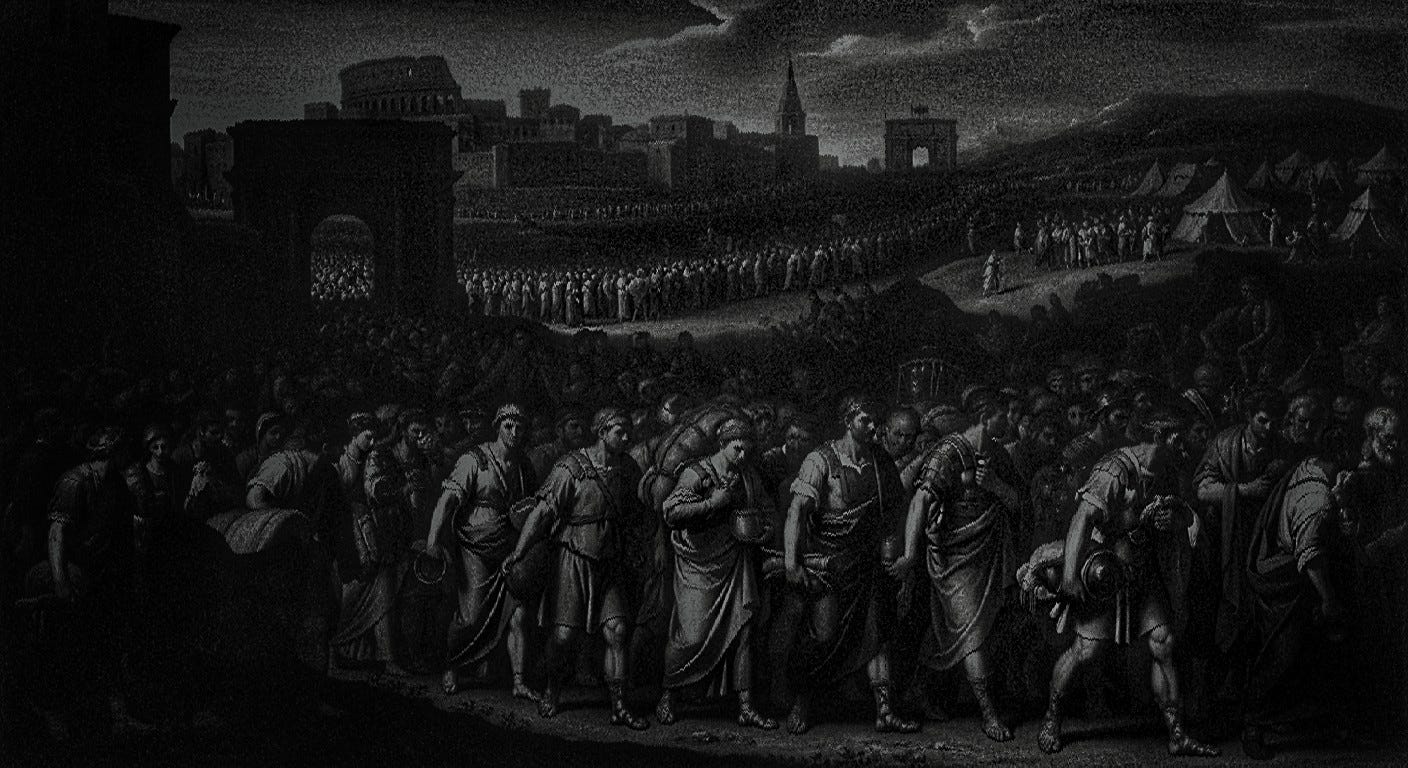
When the Roman kings would forget who built their city, the people would organize and simply leave Rome. They called it the Secessio Plebis, the secession of the plebs, the withdrawal of the people.
They would take their tools and their families and march out of the city to a nearby hill. They'd build fires, raise tents, and then they'd wait. The markets would empty, the fields would lay fallow, and the ruling class would panic. Rome had all the power, but no pulse.
Finally, the Senate would send envoys, begging them to return. The plebs would eventually agree, but only on one condition: they would have their own tribunes, chosen from among them, to speak for the people and defend them against abuse.
This was the birth of their representation. Born from withdrawal. It wasn't from speeches, or votes, or petitions. It was just the refusal to participate. That’s how the monarchy became a republic.
Every democracy since has been born from the same small acts of defiance: the moments when the people simply stop playing along.
---
IV. LABOR AS LEVERAGE
Fast forward two thousand years, and the machinery is bigger, shinier, more complex, but it runs on the same principle: human consent.
Every truck that drives, every plane that lands, every kitchen that cooks, every coder that writes, every nurse that heals, all of it happens because people agree to keep the world running.
And when they stop, the mask slips.
In 1981, the air traffic controllers, the PATCO union, tried to use that truth. They weren’t radicals; they simply wanted shorter hours and safer skies. When they threatened a strike, the illusion of control cracked. The sky itself hung in workers’ hands.
Even Reagan caught a glimpse of just how fragile the empire truly was. And so, when the rest of labor failed to stand with them, he acted. He crushed the strike by firing eleven thousand workers. He rewired the American economy to hand even more control to the ruling class, having taken it directly from the citizens.
That was the moment the modern working class lost its leverage. And the new elites have been living off that silence ever since.
But what was true in 1981 is truer now.
Every system, even one as vast as ours, depends on the rhythm of daily cooperation. Break that rhythm, and you reveal its bones.
---
V. THE POWER OF WITHDRAWAL
A strike is not chaos.
It is order rediscovered. It is the people reclaiming control over the machinery they built.
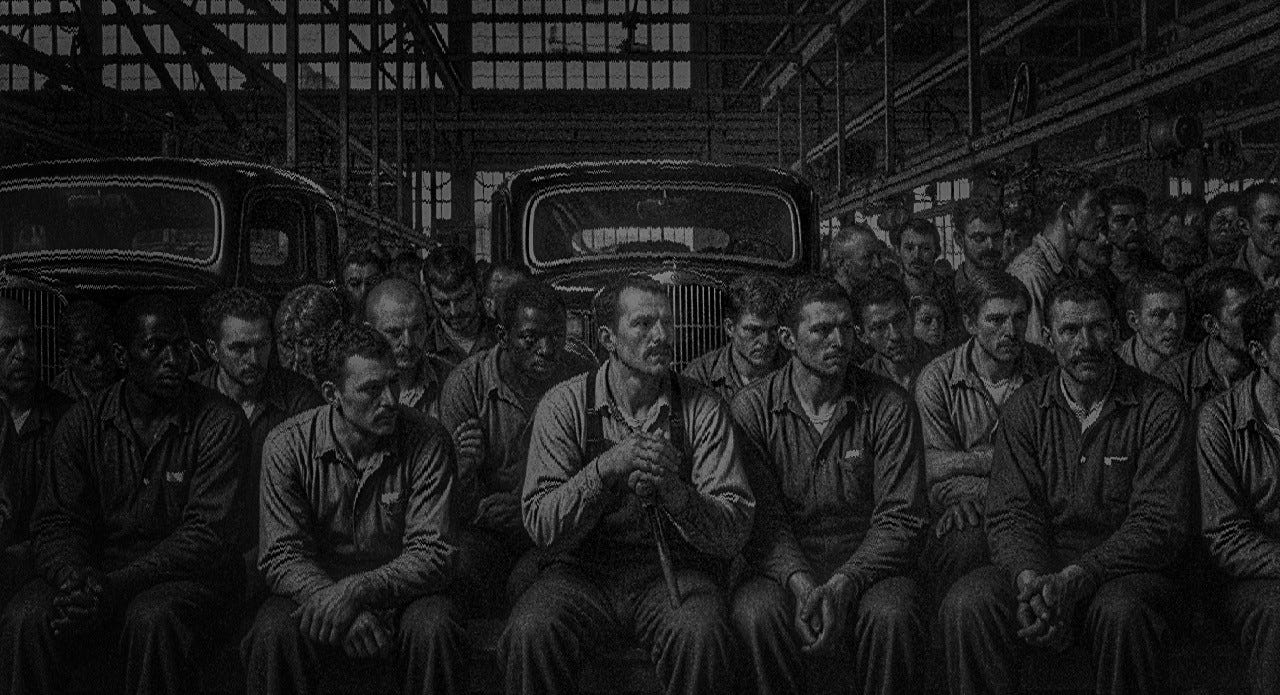
When workers in Flint occupied the General Motors plant in 1936, they didn’t destroy it; they sat down and refused to leave. The sit-down strike spread across the country and birthed modern labor rights.
When the Indian National Congress called for non-cooperation in 1920, it paralyzed the British Empire with stillness. When South Africans boycotted apartheid industries, they rewired the moral economy of the world.
Each act began the same way: with a simple refusal to continue participating in injustice.
The American experiment began in exactly the same way. A boycott, a tea protest, a strike against the empire. Our history began with refusal. Maybe it ends there, too.
---
VI. CONTAINMENT:
THE OCCUPATION
If the strike is disruption, the occupation is containment. It is the act of holding space until power yields.
This isn’t the chaos of mobs or militias; it’s the quiet gravity of citizens reclaiming ground lawfully. It’s patience made visible.
When citizens fill the corridors of power peacefully, persistently, and in the thousands, something very real happens. The government that pretends to represent them must face their physical presence. The abstract becomes undeniable.
Occupy Wall Street was a rehearsal for this. It lacked the structure to endure, but it reminded the nation that inequality has an address. For a few brief months, “occupy” became a moral word.
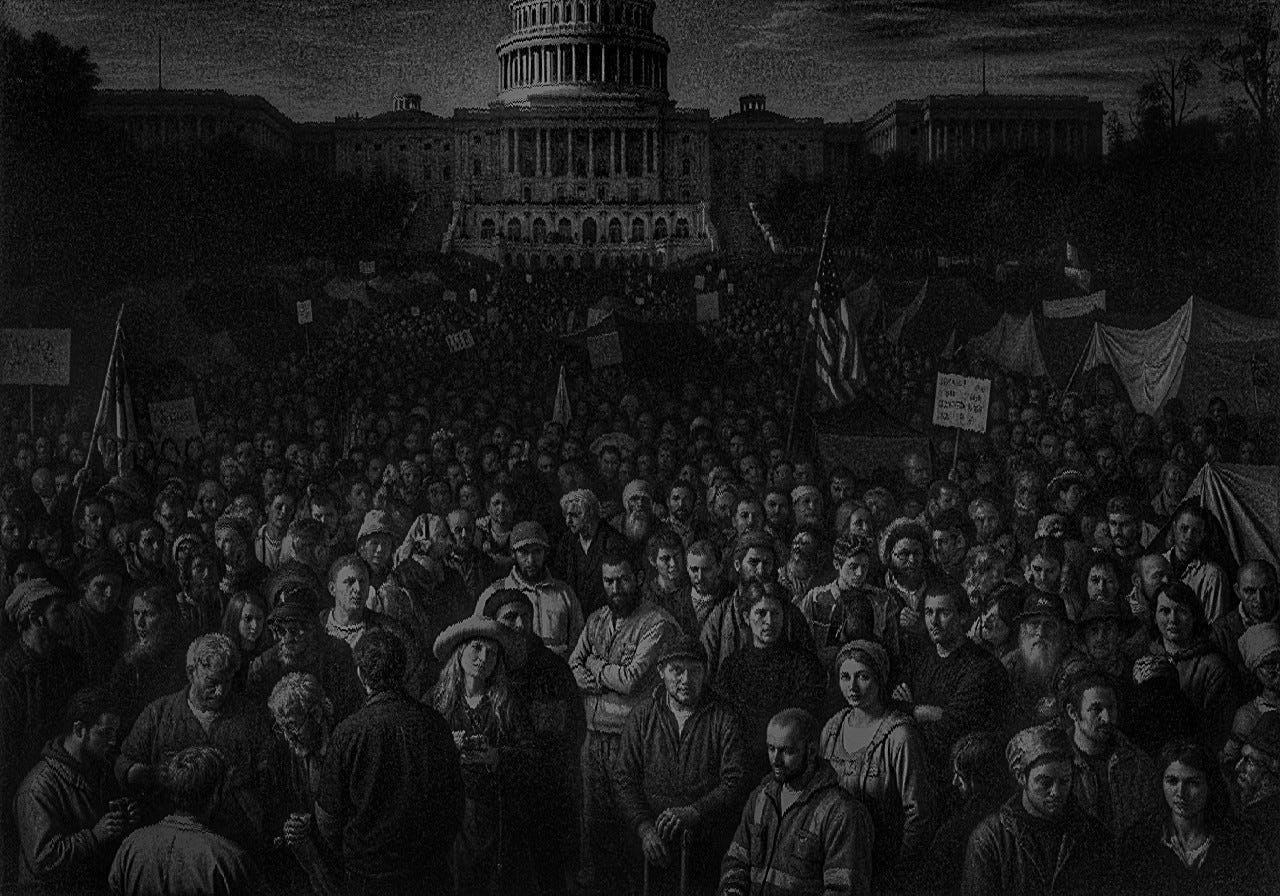
The next time must be different. The next occupations must be disciplined, strategic, sustained. Not riots, not photo ops, but civic encampments of conscience. Imagine the Capitol steps filled with teachers, nurses, veterans, and workers refusing to leave until representation means something again.
Containment, in this sense, means holding the center of power hostage to the truth with moral gravity.
---
VII. THE MORAL RECKONING
James Baldwin said that not everything that is faced can be changed, but nothing can be changed until it is faced.
This is the moment to face it.
America still believes itself innocent, which is why it refuses to repent. We cling to myths of exceptionalism even as the infrastructure crumbles, even as the machinery grinds our people to dust. We tell ourselves we're different, that it certainly could never happen here, as if empires haven't always died believing themselves eternal.
But democracy is a form of repentance. It's a daily confession that power belongs to all, and that it must be earned again every generation. Not inherited. Not seized. Earned through presence, through listening, through the hard work of sharing authority with people you'd rather ignore.
To strike is to confess: this system does not serve us.
To occupy is to confess: we have allowed power to drift from our hands, and now we want it back.
These are not acts of destruction, they are acts of responsibility. We are saying: we will no longer pretend this is working. We will no longer pretend we are powerless.
--
Now, its entirely possible that we, as a people, may still be too timid to live up to our myths. But maybe, just maybe, when we are stripped of our illusions, maybe we can still recognize each other as human, and not as just machinery that thinks, but as people who saw each other once, who built something together, and who can build it again.
And then, together, we can stop this machine just long enough to remember what it was built for.
---
VIII. THE REALIGNMENT:
POWER IN LIVING SYSTEMS
We've been taught to think of power as property. Something to seize, to hold, to accumulate and pile up behind higher and higher walls. But power is a verb, not a noun. It was never meant to be owned. Never meant to be hoarded. It was meant to flow: through systems, through people, through the living world that makes all systems possible.
Empires die. And when they do, it is ecological. The forests fall. The rivers choke. The soil exhausts itself. And the rulers, standing gloriously in their marble halls, looking over their lands, wonder why the harvests are failing and the people grow hungry.
Power misaligned with nature corrodes everything it touches: the land, the body, the future. When human systems pretend they can float above the earth that sustains them, they aren’t transcending nature. They are just collapsing more spectacularly.
What we are striking against is not only political decay but ecological arrogance. The arrogance that says growth can be infinite on a finite planet, that extraction can continue forever, that the world is just another resource to use up and toss out.
The current system treats nature the way it treats labor: as something to be exploited as long as possible and then discarded as soon as the costs become visible. Climate catastrophe is not separate from economic injustice, it's the same logic just on a global scale. The same mind that says "workers are expendable" says "ecosystems are expendable." The same system that grinds people to profit grinds the earth to dust.
To strike, then, is to refuse both. To say that neither human labor nor the living world exists to be consumed by systems that give nothing back.
And to occupy is not to dominate ground but to belong to it again. The occupation of public space becomes an act of ecological remembrance. Citizens returning not just to the corridors of government, but to the living terrain of which they are a part. You cannot occupy a place without being accountable to it. You cannot hold ground without tending it.
The Roman plebs knew this when they left the city for the hills. Their project was never to conquer new territory, or claim anything that didn't belong to them. They went to remember that their lives were not reducible to the machinery of their ridiculous empire. They went to breathe the air that belonged to no senate, to light the fires that owed no fealty, and to sleep under the stars that recognized no borders.
This is the realignment: power moving with nature, not against it. Not power over the earth, but power from it, from within the natural cycles that sustain all life. The cycles of renewal, of rest, of reciprocity.
That memory is still available. It lives in every community garden planted in abandoned lots, every river cleanup organized without permits, every mutual aid network that redistributes food before it reaches landfills. Reconstruction of power in its proper form: decentralized, reciprocal, aligned with the systems that actually sustain life.
Withdrawal, then, is not just about labor. It’s a broader refusal of consent. It's a decision to stop fueling an unsustainable machine.
And an occupation is not just about reclaiming physical public space from private power. It's reclaiming our relationship with the ground itself, a recognition that we are not rulers of nature but participants in it.
This is how a republic stays alive: by finding its rhythm again. By breathing in rhythm with the world that made it possible. Through devotion, not domination.
Power properly aligned with nature doesn't accumulate and create barriers and blockages; it moves, it circulates. It feeds, it builds, it renews. This is the power worth fighting for. This is the power worth building.
This is not some retreat from civilization.
This is what civilization was supposed to be.
---
IX. THE RETURN OF CITIZENSHIP
This understanding of power, that it is for circulation rather than accumulation, changes the meaning of citizenship. Citizenship isn’t simply paperwork. It’s participation. It’s knowing that the nation belongs to the ones who show up, who breathe the air, drink the water, and tend the soil.
The empire cannot function without the consent of its workers, its drivers, its teachers, its doctors, its dreamers.
A general strike isn’t some absurd abstract fantasy; it’s a powerful, dignified declaration of interdependence.
And an occupation isn’t an insurrection; it’s a reclamation.
To strike is to say:
“You cannot have my labor until it serves my life.”
To occupy is to say:
“You cannot have this power until it serves the people.”
That’s the purest patriotism there is.
---
X. THE TWO STEP
So here it is, simplified: the citizens’ guide to ending an empire:
Step One: Disrupt.
Withdraw your labor, your data, your money, your silence. Refuse to turn the gears.
Step Two: Contain.
Organize and occupy the centers of power as peacefully, and persistently, as possible, until they bend back to the public will.
Strike and occupy.
Disrupt and contain.
This is not a call to chaos. This is a call to purpose. This is a call to take back responsibility for the world that claims to represent you.
Every empire forgets what built it.
Every people, when cornered, remembers.
The rest is only a matter of courage.
.:.